Product, Growth, and Torque
When thinking about the dynamic between product and growth, it is useful to borrow tools from physics, such as the concept of torque.
The formula for torque is:
τ = r·F·sin(θ)
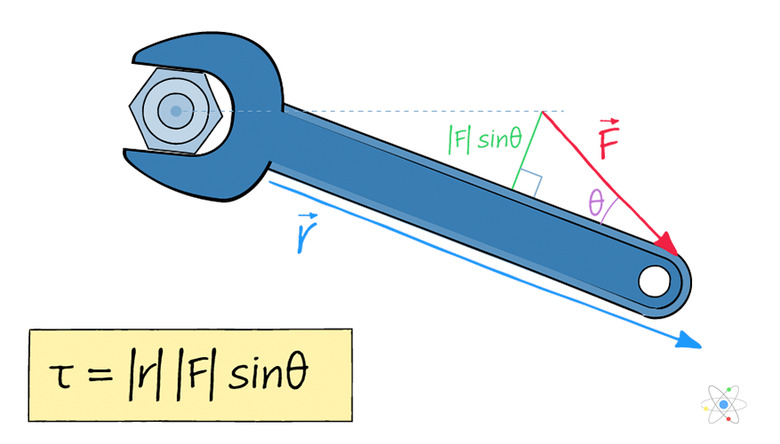
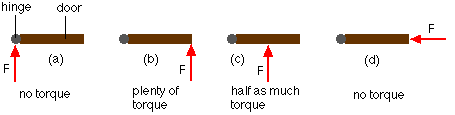
Where τ = torque, r = radius, F = force, and θ = the angle between the lever arm and the vector force.
Mapping each variable onto product and growth:
- Radius is proportional to the quality of the product
- Force is proportional to the volume of growth
- Theta is proportional to the alignment between product and growth
The best case scenario:
- Quality of product is as high as possible. You have a very long lever.
- Force is as high as possible. You are pushing very hard.
- Theta is 90 degrees (sin θ = 1). Every unit of growth is applied in exactly the direction in which the product creates value.
The worst case scenario:
- Quality of product is zero. You have no lever.
- Force is zero. You are not pushing.
- Theta is 180 degrees (sin θ = 0). Every unit of growth has zero effect in the direction in which the product creates value.
You obviously should aim to optimize all 3 variables, but at the same time, you cannot have just one of these maxed out and your other variables untouched or else your net torque is zero.
The asymmetry
A great product with terrible growth outperforms a terrible product with great growth.
Yet it is much harder (although it is becoming a lot easier with AI) to create a truly great product than it is to do growth.
To truly create a great product, you have to figure out who your users are, talk to a lot of them, figure out exactly what problem they are facing, then through repeatedly testing different hypotheses, figure out the best solution to that problem, while having the technical brilliance to actually create the best solution. Then you also have to constantly adapt and grow with users as their needs expand and change.
Growth is much more simple. You post another Instagram reel or send another cold email or run another ad campaign. These are highly repeatable things that you have done plenty of times before, which is why people do it so much.
Back to the lever system, if you want to move the lever a certain distance, the obvious thing to do is to just push harder.
The non-obvious thing to do is to push at a distance farther away from the axis or throw away the lever completely and get a longer lever.
The feedback loop trap
Whenever you make a successful cold call, it is immediately rewarding.
Over time, your brain forms a very strong association between cold calls and progress.
So you do more of it.
You go from making a couple cold calls a day and working on product the rest of the time, to taking hundreds of cold calls a day and only working on product for a couple hours.
This is where you get stuck in the trap of linear growth. In fact, one could argue this is even logarithmic growth as you exhaust your best leads for the same product over time.
Improving product by a marginal amount is not immediately rewarding.
It is hard. And most of the time, it is even harder to know if you are going in the right direction until months down the line.
Therefore, people naturally lean towards growth because it is simple and repeatable while also immediately rewarding. While leaning away from directly improving the product because of uncertainty and lack of immediate reward.
Ultimately, it is the accumulation of incremental improvements to the product, leveraged by principled growth, over decades that results in the greatest reward of all. And at that point, the word "reward" does not do it justice. At that point, you have built something truly generational that solves a big problem, very well, for a lot of people. And that is what truly matters.
"You can take two years to build something exceptional, then let your customers market it forever. Or, you can take two months to make a mediocre product and spend the rest of your life trying to sell it." — Alex Hormozi
What I am not saying is just go all in on product and forgo growth entirely. That would lead to the same zero net torque failure mode I warned against at the beginning of this essay. What I am saying is that there is this natural inclination, fueled by operant conditioning, towards growth and away from product, and that oftentimes, the bottleneck to break out of linear growth is relentlessly obsessing over product instead.
Nuance
One of our investors, Peter Thiel, once said:
"If you've invented something new but you haven't invented an effective way to sell it, you have a bad business, no matter how good the product."
This reveals two sides of the coin:
invention of the product : invention of selling the product
This places equal weight on product and selling. Yet the difficulty discrepancy from before still stands. From Peter Thiel's perspective, both are equally important, and both require invention. Yet, the mental model we've been developing adds nuance that one is more difficult than the other and that people are naturally inclined to focus on one versus the other without even noticing.
The future of this essay
There may very likely come a time in a post-AGI world, where the difficulty of creating a truly great product becomes near zero and thus the only thing that practically matters is growth and taste (what to build).
Right now, extremely powerful tools like Claude Code already exist that can build almost anything you tell it to. But at the end of the day, you still have to tell it to build something. In order to build a great business, there still needs to be brilliant humans telling the AI what to build (by talking to users, testing hypotheses, etc.).
But what if AI could do that too? What if AI could talk to users directly, parse massive amounts of data on what people actually want, prompt itself to build the perfect product and solution, then track real results on the product's performance, and constantly iterate on the product to maximize value output to humanity?
Humans have already taken a stab at this, such as Andon Labs building Vending-Bench 2, which lets AI run a vending machine business, the most atomic unit of a business, and benchmarks its performance by ending bank balance.
We are ultimately trying to build the entire vision of this hypothesis at Symbal.
Symbal is the Economic Research Lab — the Platonic Ideal of AGI.
Notes: The ideas in this essay are not mine alone. I pull inspiration from investors like Peter Thiel, entrepreneurs like Alex Hormozi, and personal friends like Audrey Lo.